


1. Materials Management at ReVisionz
In this video, you’ll learn how ReVisionz approaches materials management as a dynamic, end-to-end process that drives efficiency across digital projects and operations.
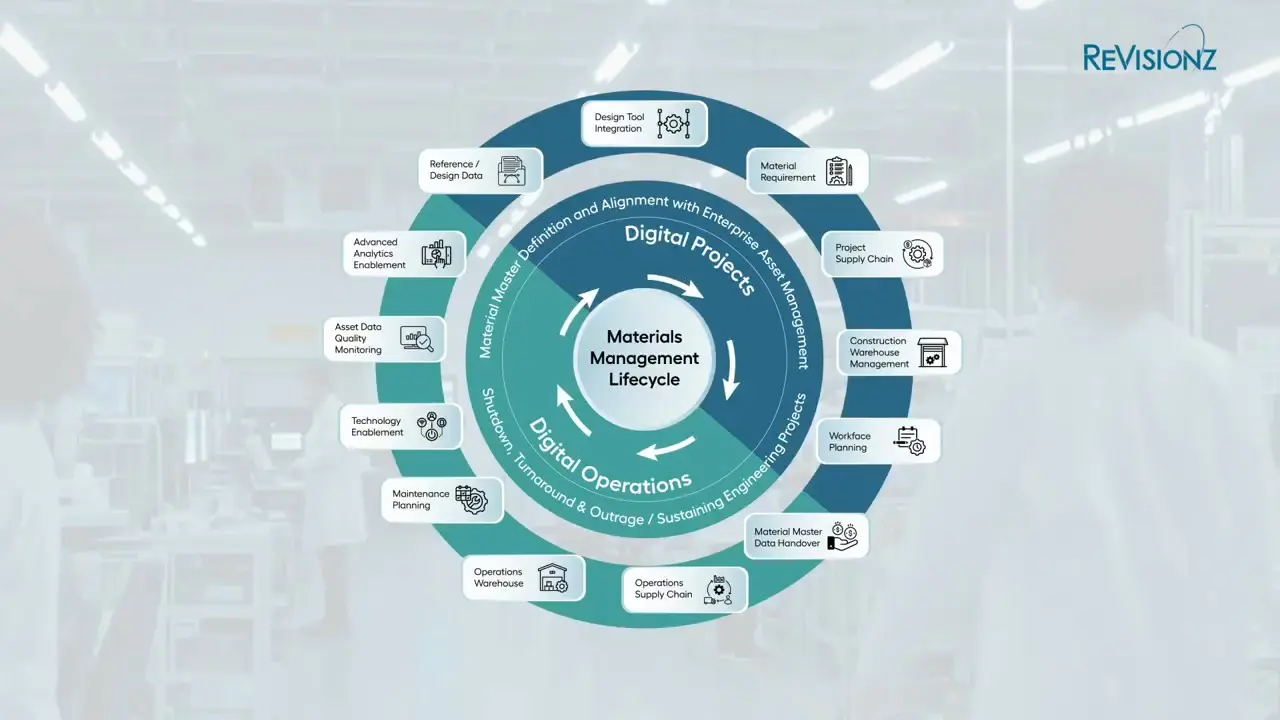
From material master definition through procurement, construction and ongoing maintenance, the video walks through each stage of the materials management lifecycle and how it supports seamless supply chain execution. You’ll see how a connected materials management approach improves coordination between teams, eliminates supply chain blind spots, and helps ensure the right materials are available when and where they’re needed.

2. Introduction
Then & Now
Thirty years ago, asset data was commonly siloed and required time-consuming and meticulous manual entry by multiple stakeholders. Project schedules were built around this reality, accommodating the delays and complexities of manual data capture.
Today, however, project schedules tend to assume streamlined processes and efficient data management, which is not always the case. While tools and systems have evolved, the underlying challenges of data consistency and information flow are persistent.
The Push Toward Digitization
In recent years, there has been a strong push towards digitization, especially within industrial sectors. But digitization is more than simply working in Excel files with VB macros or enabling collaborative work in the cloud. It involves a more in-depth process of contextualizing information and connecting it across systems. This is essential for utilizing AI effectively and obtaining accurate results, as well as enabling real-time key performance indicators (KPIs) and reporting.
As organizations have advanced their digital capabilities, the need for structure and consistency in how data is managed has become increasingly clear. Practices such as data governance are now more mainstream, driven by the creation and adoption of international standards such as CFIHOS (Capital Facilities Information Handover Specification) and ISO (International Organization for Standardization) 15926. Additionally, governance standards like the Petroleum Industry Data Exchange (PIDX) and vendor-specific standardizations have also gained traction. These advancements have laid the groundwork for a more agile data-driven project execution model.
The Case for Trusted Data
To achieve a fast and agile project start, organizations should have access to a repository of validated and approved data. Reusing trusted information across the enterprise rather than having siloed and redundant data, improves quality and accelerates smart decision-making.
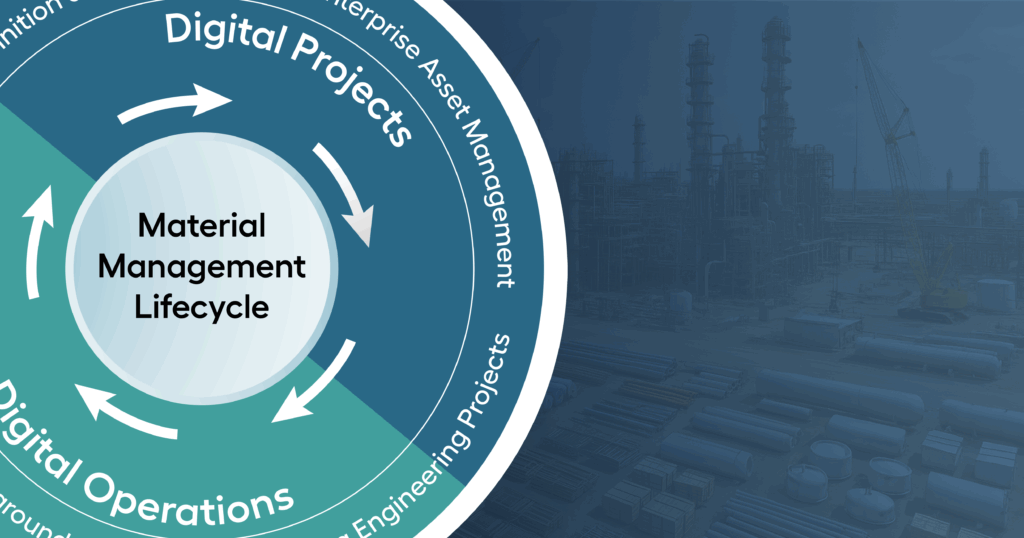
This vetted data should be streamlined into a standardized integration map tailored to an organization’s needs. Prioritizing integration allows systems and tools such as design platforms, Enterprise Resource Planning (ERP) systems and maintenance applications to exchange information seamlessly and report changes that require action. One of the most critical areas where trusted, integrated data has a direct impact is the materials management lifecycle, which enables continuous alignment between digital projects and digital operations for consistency and efficiency across every stage of the asset lifecycle.
The process begins with the definition of Material Masters and their alignment with enterprise asset management systems. This foundational step enables data that is accurate and actionable from the outset. Reference and design data are then captured and integrated into design tools, which transforms raw information into precise material requirements.
These early activities form the backbone of a well-orchestrated supply chain. From procurement to warehouse management and workface planning, each stage supports timely execution, prevents bottlenecks and helps maintain control throughout the project.
Materials management is a continuous process that extends into operations and supports long-term performance. Organizations that view it as a dynamic, evolving cycle are better positioned to optimize asset reliability and lifecycle value.
Legacy Barriers to Efficiency
In industrial facilities, Material Masters used in CAPEX with a focus on bulk components and tags frequently differ from those developed in the operations phase. This misalignment exacerbates inefficiencies and sometimes causes duplication or misidentification of materials.
Commodity definitions are often seen as company-specific intellectual property, leading to more time spent on definition, system setup, data management and governance. Instead of building on existing standards, organizations spend valuable time reinventing the wheel.
Historically, standardization was primarily applied in manufacturing hubs such as the automotive industry, where repeatable parts, assemblies and finished products were expected. It was perceived as more suitable for specialized industries rather than the norm. As a result, standardization was seen as more appropriate for specialized sectors rather than broadly applicable across most capital projects and industries.
This becomes especially problematic after project turnover, when materials management continues to play a critical role in supporting long-term operations, sustaining capital projects and managing planned shutdowns and turnarounds. Effective material master data handover is essential to preserve critical data and to enhance it for use in ongoing operations.
At this stage, the focus shifts toward spare parts acquisition, inventory optimization and the efficient movement of materials through warehouses and supply chains, all of which directly support maintenance planning and reliability.
Modern technologies like Radio Frequency Identification (, real-time location tracking and operational software improve visibility and streamline execution. Meanwhile, data quality monitoring fosters reliable information and advanced analytics help translate raw data into predictive insights.
These tools both enhance visibility and provide the insights needed to anticipate material needs, reduce downtime and support proactive maintenance. This level of operational intelligence transforms materials management from a back-office function into a driver of reliability and performance.
Why the Industry Needs Disruption
For years, materials management has been limited by fragmented systems, manual processes and disconnected workflows. Despite advancements in technology, many organizations continue to rely on outdated practices that hinder efficiency and visibility.
This is typically not due to a lack of tools or poor process design, but the natural tendency of teams to revert to familiar habits and legacy ways of working. In fact, the biggest obstacle after committing to digital transformation is not technology, it’s the people’s resistance to change. Fear of disruption and reliance on old methods can quietly stall even the strongest digital strategies.
But here’s the truth. Disruption is exactly what we need. Progress depends on intentional, coordinated change.
Replacing reactive workarounds with integrated, data-driven strategies improves accuracy and streamlines execution across the asset lifecycle. With modern tools, standards and analytics, materials management can become a continuous, scalable process that supports both project delivery and long-term operations.
There hasn’t been a better time to move beyond the status quo and realize the full value of a connected materials management approach. That’s why ReVisionz works with organizations to break through the common barriers that hold materials management back.
By aligning governance, integration and data structures from project to operations, we help teams move faster with fewer disruptions. Our approach reduces the friction caused by disconnected systems and supports a more reliable, data-driven foundation for maintenance, planning and long-term performance.
Follow the full ReVisionz series on mastering materials management by subscribing for updates. If your organization is ready to take a closer look, get in touch with us to start building a plan that fits your goals.
3. Material Master Definition
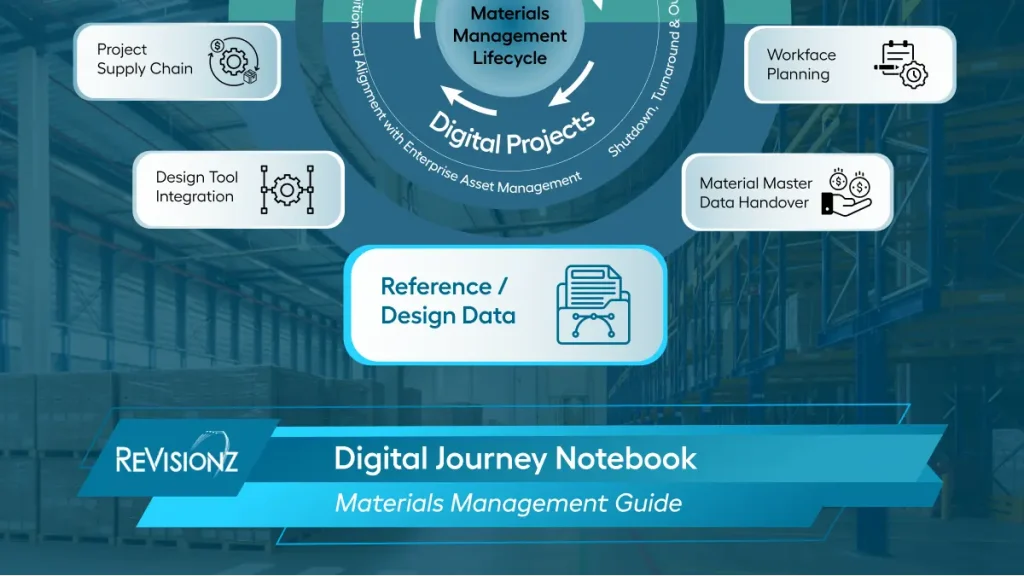
A successful materials management strategy begins with how materials are defined. Whether you’re planning a capital project or operating a facility for decades to come, material master definition is the starting point. It establishes the structure for everything that follows, from requirements gathering to procurement, logistics, warehousing and maintenance.
While material master planning is critical during CAPEX, its greatest impact is realized in operations. Running a facility for the next 40 years or more requires a deeper understanding of how digital transformation impacts data quality, accessibility and decision-making.
Concepts like connected data, APIs, AI, data warehouses, cloud computing and real-time dashboards or end-to-end-visibility solutions are now fundamental to should be part of every day discussions.
Getting Started
The entry point to this workflow is material definition. This is the single most important step when an organization invests in optimizing materials management. However, it’s easy to get overwhelmed at this stage because it demands alignment across technical specifications, standardization of data within fragmented systems and coordination among multiple departments.
If ownership is unclear or governance is not in place, the effort quickly produces duplication and inconsistency. These problems ripple through procurement, fabrication, construction and maintenance, creating inefficiencies that grow larger as the asset lifecycle progresses.
To avoid these pitfalls, organizations benefit from breaking the effort into well-defined phases or working with a partner who can guide them through both risks and opportunities.
When considering material definition, start by evaluating your current systems and processes. Even if you’re starting from scratch, there is a current method in place for managing your assets.
Key Questions to Ask:
- What technologies are currently in place to manage your master data?
- Are there clear business processes in place for creating, updating and maintaining your material master?
- What are the pain points in the current process?

Data Quality & Governance
Once material definition is underway, the focus should shift to data quality and governance. These topics don’t need to be finalized at the start, but organizations should have a clear understanding of their importance and a plan for adoption.
Establishing a strong data foundation includes defining taxonomies, data validation rules and governance structures. With this foundation in place, organizations can develop frameworks to monitor and maintain the ongoing expansion of the dataset. These concepts will continue to be enhanced as organizational maturity increases, which will ultimately drive ongoing innovation.
Key Questions to Ask:
- How is data quality and consistency handled today?
- What are the key components of data governance to my organization?
- How will my organization comply with data governance policies in the future?
Taxonomy
Defining taxonomy rules, descriptions, material types, categories and physical characteristics (such as dimensions, weights and center of gravities) is one of the more resource-intensive parts of material definition. This work requires cross-functional collaboration and strong business process ownership.
Depending on the scope of the material master, you may need a dedicated team of SMEs willing to engage and collaborate to consider the end-to-end requirements. Drawing from existing standards like CIFHOS, ISO 15926 or PIDX to meet your organizational requirements can provide a strong starting point. However, these standards will have to be continually challenged as business needs and technologies evolve.
Key Questions to Ask:
- Is there a clearly defined and supported business process owner?
- What are the taxonomy rules and descriptions needed for material types and categories?
- How will physical characteristics be documented and maintained?

Integration & Interfaces
Integration is a very complex phase of material master development. It requires careful prioritization, and the development process does not always follow a linear path. This phase also has a considerable influence on the types of data required during material definition. Understanding data ownership, usually at the attribute level, adds to the complexity and demands clarity on responsibilities.
Along the value chain, different owners will take responsibility for populating their portion of the data, which will impact the overall trust of a given asset. It is essential at this stage to identify and define the key applications that will either maintain the material master or publish data throughout the evolution of the asset.
During CAPEX, integration frequently resides within the Master Data Management (MDM), engineering tools, ERP, Electronic Document Management Systems (EDMS), Project Management (PM) software and construction planning tools. In operations, on the other hand, interfaces will include MDM, ERP, CMMS, PLM, EDMS, PM and EAM technology. Plotting out a high-level integration architecture will help drive prioritization and define a strategic roadmap for the future.
Key Questions to Ask:
- What are the key methods, standards and system requirements for integration across the value chain?
- How is material master data structured and formatted across systems?
- How often does data need to be synchronized between interfacing systems?
Roles & Responsibilities
Clear roles and responsibilities foster accountability and high-quality data management. Additionally, demarcation of a well-defined data structure enables cross discipline collaboration, proactive data management and streamlined processes throughout the asset lifecycle.
With this understanding, organizations can facilitate better data compliance within the organization and to industry standards. Potential results include faster and more strategic decision-making, reduction in errors due to outdated or inaccurate information, and cost savings through resource optimization.
Key Questions to Ask:
- Who is authorized to create new material master records?
- What responsibilities do data owners hold for each data element?
- What mechanisms will ensure consistent data usage across departments?
- What training programs will be provided to ensure stakeholders understand their roles and responsibilities?
Audit, Reporting & Analytics
Having a clear process for auditing, reporting and analyzing material master data creates an environment of transparency. Prioritized data, real-time access, defined matrixes and KPIs lay the groundwork for AI integration, which can create a continual feedback loop for continuous improvement.
Key Questions to Ask:
- Where are all the sources of information and how will they be integrated?
- How will we verify the accuracy of the material master data?
- How will audit findings be reported and addressed, and who is responsible for resolving findings?
- What type of reporting/dashboard is expected and who is the audience?
Thinking About the Future
When the foundational elements listed above work in concert, the result is not only improved operational consistency but also measurable cost savings and performance benefits.
Cost savings are typically realized across the following areas:
- Administrative Efficiency: Up to 5-10% reduction in administrative costs due to streamlined processes and reduced errors.
- Project Cost Control: Potentially 5-15% reduction in project costs through accurate material data and efficient resource allocation.
- Compliance & Risk Management: Approximately 5-10% reduction in compliance-related costs by ensuring data accuracy and regulatory adherence.
In addition to financial returns, the greatest intangible benefit is trust in the data. While this variable is difficult to quantify, it is essential for quick responses and confident decision-making. With these building blocks in place, organizations can begin to capture and structure material data that spans the entire lifecycle.
This process is ongoing and will continue to expand to optimize other opportunities within materials management. And as organizations continue to mature, a knowledgeable partner can help accelerate this process. With the right support, companies can avoid common pitfalls, optimize implementation and build internal capacity more efficiently.
Most organizations in the industrial engineering space start with piping or bulk commodities. On the other hand, most operational facilities will focus on assets or critical tags. Regardless of the entry point, applying these principles across the entire lifecycle brings greater value than limiting efforts to a single phase.
This is where ReVisionz adds structure and clarity to an otherwise complex and resource-intensive effort. We help organizations define, operationalize and sustain material master strategies that align with real-world use cases and system demands to close the gap between project priorities and operational needs.
Our team combines more than a century of collective experience in materials management across both engineering and operations. This mix of subject matter expertise and business consulting gives organizations a practical advantage, especially when they are just beginning the journey. By drawing on lessons learned from past projects, we provide the insight needed to avoid common pitfalls, accelerate adoption and embed practices that deliver lasting performance.
Continue to reimagine each of these key elements as you embark on the journey of material master definition. A well-integrated strategy enables organizations to transform materials management from a static task into a strategic capability that powers performance across the entire asset lifecycle.
Stay informed as the ReVisionz series continues to explore connected, lifecycle-based materials management. Subscribe for updates or connect with us directly to discuss your priorities.
4. Integration
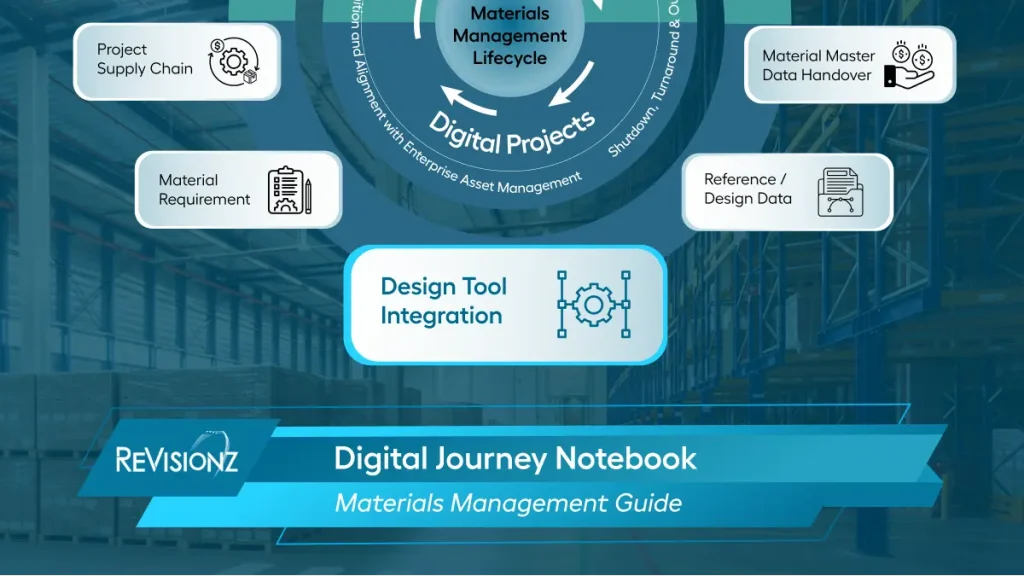
The next step for materials management is understanding system integration. For Materials Masters, this typically begins with an organizational Master Data Management (MDM) system. With the foundational information that we provided in the previous Material Definition article, you should now have a functional understanding of your MDM environment. However, this is only the beginning.
The lifecycle of material data begins at object creation and extends throughout design, procurement, construction, operations, maintenance and ultimately decommissioning. Each phase relies on seamless data flow to eliminate rework, improve visibility and reduce lifecycle costs.
Integrating Design Tools With Material Masters
Integration capabilities were minimal in the mid 90’s. An organization was considered “advanced” if it could combine CSV files into an access database to generate a report. Truly connected data was left up to movies and science fiction shows. Today, it is the norm. Integrated data environments are essential for realizing efficiency gains and supporting strategic objectives.
In project materials management space, once Materials Masters are defined, they need to be passed to 3D design tools to general Bills of Material (BOMs). This step supports the procurement and supply chain process by organizing material needs by functional location and helping ensure on-time delivery for fabrication or construction.
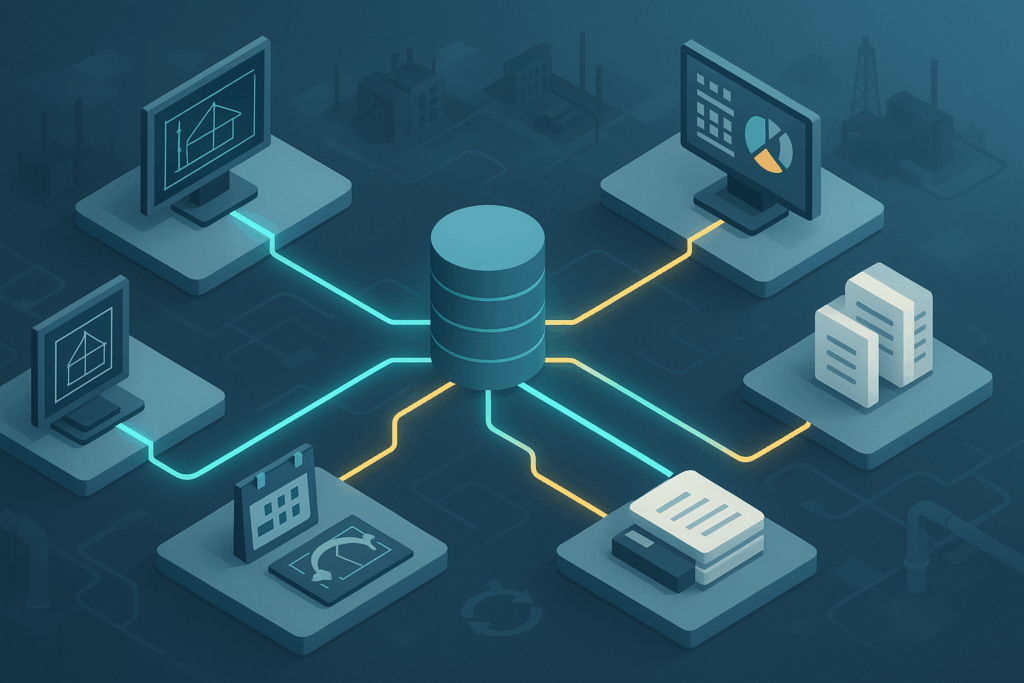
Here are some of the key applications that could be connected beyond the material master data coming from an MDM:
- MDM
- 3D Design Tools (such as CAD platforms)
- Project Controls
- ERP
- EDMS
- EAM and CMMS platforms
- Product Lifecycle Management (PLM)
- Reporting Dashboards and Analytics Tools
Types of Integration
As you start to consider integration, it’s important to prioritize the needs along with complexity and business value. Integration has a cost, so efforts should focus on areas where connectivity will have the greatest value. Integration really depends on the business needs and where the greatest impacts will be felt. Organizations should assess integration opportunities not just from a technical standpoint, but from a process improvement and long-term scalability perspective.
To support this process, it helps to break integration planning into two categories. The first includes typical core systems used during capital projects, where accurate and timely data is critical. The second includes broader systems that come into play during later stages of the asset lifecycle or support ongoing performance management.
#1. Typical Project Integrations:
- 3D Design Tools
- Project C
- EDMS
- ERP
#2. Further Considerations:
- EAM
- CMMS
- PLM
- Manufacturing/Construction Tools
- Reporting Dashboards
Not all of these should be tackled at once, but starting with the end in mind and seeing the full strategy will reduce missed opportunities or concerns with connecting data.
Key Questions to Ask:
- Where would integration bring the most value and why?
- How would I measure success against each integration type?
- Do I have the organization to support the type of integration I want?
Integration Requirements
Establishing integration requires clear objectives, an understanding of your current systems and processes, and a well-planned architecture. In many cases, middleware or an integration platform is needed to facilitate communication between systems.
Suggested Best Practices:
- Clearly define the integration scope and align it with business goals.
- Map inputs and outputs across systems to avoid gaps.
- Evaluate middleware or integration platforms for scalable, reusable connections.
Key Questions to Ask:
- What data needs to be shared across systems?
- What standards and protocols will be used for integration?
- How will integration performance and reliability be monitored?
Data ownership is a critical aspect of integrating design tools within industrial engineering companies. It ensures that there is clear accountability for the data, which is essential for maintaining data integrity and security. When data ownership is well-defined, it helps in establishing who is responsible for data accuracy, updates and compliance with regulatory requirements.
It also plays a key role in identifying and maintaining a clear source of truth for data across systems, ensuring that all stakeholders are working from the same validated information. This clarity prevents confusion and ensures that data management processes are streamlined and efficient. Moreover, data ownership fosters a sense of responsibility among stakeholders, encouraging them to take proactive measures to protect and maintain the quality of the data.
Developing a RACI (Responsible, Accountable, Consulted and Informed) matrix is equally important in the context of integration. A RACI matrix clearly outlines the roles and responsibilities of all stakeholders involved in the integration process. It helps in identifying who is responsible for specific tasks, who is accountable for overall success, who needs to be consulted for their expertise and who should be kept informed about progress and decisions.
This structured approach ensures that everyone knows their role and reduces the risk of miscommunication and overlapping duties. By establishing a RACI matrix, organizations can manage the integration process more effectively so that all aspects are covered and that the transition is smooth and efficient.
Key Questions to Ask:
- Is there an existing data organization within your organization to provide overall governance?
- Who will be the data owners and what are their responsibilities?
- How will changes be managed within the data organization?
Data Synchronization
Data synchronization is vital to integrating design or operational systems because it ensures consistency across all systems, tools and processes. When data is synchronized, all stakeholders have access to the same, up-to-date information, which significantly reduces errors and discrepancies.
Synchronization streamlines workflows by automating data updates, saving time and reducing the need for manual intervention. This efficiency not only enhances productivity but also allows engineers and operators to focus on more critical tasks rather than data management.
Additionally, data synchronization facilitates better collaboration within teams. When everyone has real-time access to the same data, it improves communication and coordination, leading to more effective teamwork. This is particularly important between the different stages of projects including engineering, procurement and construction, into operations involving multiple stakeholders and complex processes.
Lastly, data synchronization helps in maintaining regulatory compliance by ensuring that data is consistently updated and accurate across all systems, which is crucial for meeting industry-specific regulations and standards as well as enabling quicker maintenance, planned changes or plant upgrades.
Key Questions to Ask:
- What are your primary data sources?
- What systems are currently in use and are there specific security protocols to consider?
- What is the volume and how frequently does your data change and need to be synchronized?
Change Management & Scalability
Information is rarely static. It will continue to evolve as it flows throughout the process and along its data chain. Understanding how that data will change and around the specific processes of change is important when defining integration.
Scalability is another critical factor. As your organization grows or adopts new tools and processes, your integration architecture must be able to accommodate additional data volume, formats and workflows. Anticipating these needs upfront helps avoid costly redesigns later.
Key Questions to Ask:
- How will architecture accommodate future growth and what are the scalability requirements?
- How will data change throughout the process? Does it get overwritten, augmented or are historical records required for data comparison?
- What flexibility is needed to adapt to changing business needs?
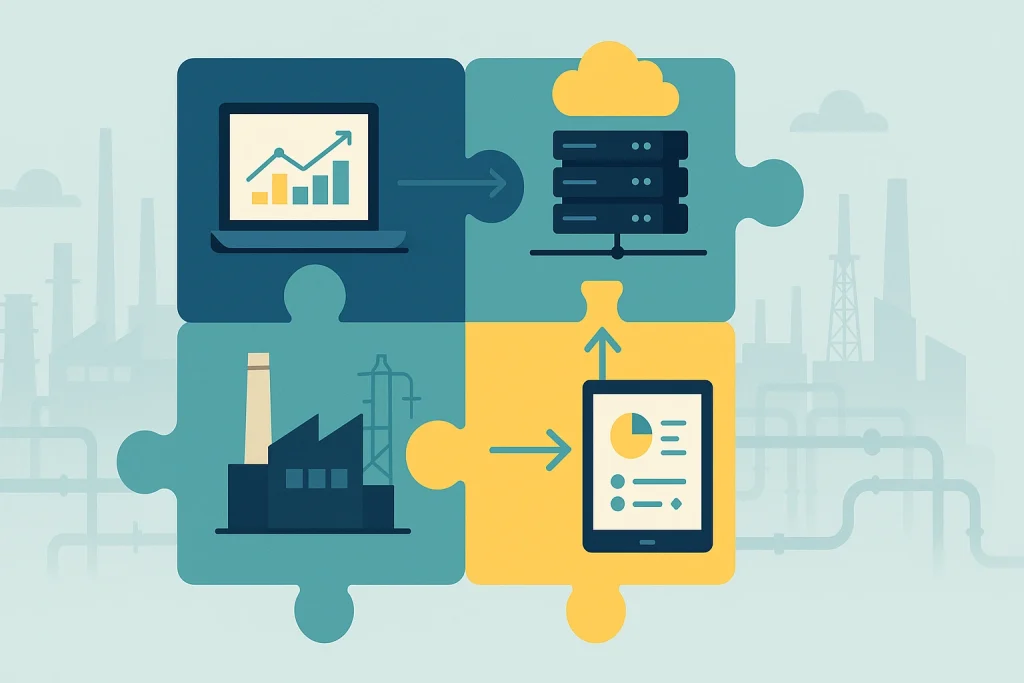
Putting the Pieces Together
All the above components go into a well-designed landscape. Cost saving typically in a properly designed integration deployment can be in the seen following areas:
System Design
Understanding integration requirements is important, as it helps prevent costly design issues such as overdesign, increased complexity, or data being unavailable at the right time or in the right tools to meet business demands. Ignoring these considerations can result in higher costs, lower user adoption, implementation delays and operational disruptions.
Collaboration/Alignment & Stakeholder Engagement
Integration is about intertwining data from multiple sources. This is often disruptive to existing ways of working and overall resource comfort levels. Telling people that “this will be better” is not a recipe for success. To promote trust in the new path, this has to be built with early collaboration and feedback, alignment between stakeholders and early adoption, sufficient resource involvement and buy-in from key users.
Data Quality
Ensuring proper data quality through well-mapped business processes, validation and cleansing helps mitigate migration issues and reduce data mistrust. Providing adequate time for training and testing further improves data quality and confirms that data has been correctly structured and mapped.
Lessons from the Field
When integration is not approached with careful planning and alignment across system design, stakeholder engagement and data quality, the consequences can be significant. In some cases, project budgets have increased by as much as 25% due to rework, poor adoption or data issues.
One high-profile example is Nike’s ERP and supply chain integration project, which encountered major delays and cost overruns due to challenges in system alignment and readiness. For a deeper look at how integration missteps can impact business outcomes, see the full case study here.
Thinking About the Future
Integration continually evolves. New integrations will become available, different methods for integration are developed, and business needs change. Having a regular review cycle, a minimum of every three years, should be established. This doesn’t mean you need to change every three years, but understanding what changes are available, coming, and required will enable a company to be reactive and responsive to new business demands.
As part of that forward-looking approach, it’s also wise to seek out external expertise and leverage lessons learned. Benefiting from challenges and experiences from others can provide you with an expedited pathway to success. Although not every company’s journey is the same, there are often common threads. Not repeating known pitfalls can sometime have significant cost savings and also provide valuable insight into other opportunities or faster deployment.
ReVisionz brings a structured yet flexible approach to integration planning that’s grounded in real-world project experience and deep technical knowledge. We help organizations define scalable integration architectures, clarify system roles and align long-term priorities across digital project and operations environments. This allows clients to move with purpose, avoid missteps and build integrations that remain resilient as tools, teams and business requirements evolve, ultimately accelerating return on their digital investments.
To follow the rest of the ReVisionz series on materials management, subscribe to our Digital Journey Notebook. You can also connect with us directly for a personalized approach that fits your organization’s needs.
5. Material Requirements
Now that we have defined a material master and understand how it’s connected to the larger organizational ecosystem through proper integration, the next critical phase of the materials management lifecycle is collecting the precise material requirements.
During this phase, the engineering drawings, specifications and design data are converted into a comprehensive, actionable materials list that drives the entire procurement and construction process. For asset-intensive industries, where the wrong valve or misidentified pipe can cause significant delays and safety risks, accuracy at this stage is paramount.
The goal from a CAPEX or project perspective is to be able to collect the material requirements to understand material demands and trends that will define the procurement needs. The method for aggregating material requirements will differ depending on the strategy set forward in the Materials Management Plan (MMP).
In CAPEX projects, materials are typically aggregated at the area or Engineering Work Package (EWP) levels to maximize quantities during the requisition process. Within operations, this is typically done at the work order level to support maintenance activities. There are other supply chain strategies that will also come into play, which will be discussed in the next chapter.
In the digital-first environment described in previous chapters, the process of gathering requirements is no longer a slow, manual handoff. Instead, it’s a dynamic, integrated process where data flows seamlessly between design applications and enterprise systems.
Establishing this digital foundation ensures that material requirements remain accurate, traceable and aligned with both project execution and long-term operations. This chapter will outline the key aspects to consider for gathering material requirements.
Materials Management Solutions
A core element for effective material requirements is to employ a materials management solution because relying on patchwork processes is a critical vulnerability.
The old paradigm, where complex projects are managed with disparate spreadsheets, manual processes and isolated data sources, creates a breeding ground for errors, delays and financial risks. Each time data is manually transformed or re-entered, the risk of inconsistency and human error multiplies. What starts as a simple list of required materials in an engineering department morphs into a complex, unwieldy artifact by the time it reaches procurement, logistics and the construction site.
A modern, intentional materials management solution, however, replaces these disconnected activities with a cohesive and integrated process. By serving as a single, central hub, it eliminates the need for complex, error-prone spreadsheet macros and manual data manipulation. Instead, it automates the flow of trusted data from design and engineering directly into all subsequent project activities, including vendor management, procurement, warehouse logistics and long-term operations.
The solution acts as the central nervous system for all project materials so that accurate and enriched material data is accessible to all stakeholders in real time and is consistently carried through every stage of the asset’s lifecycle. This not only streamlines project execution but also builds a robust, reliable data foundation for maintenance and operations well after project handover.
To assess your own situation, look at the number of manual interventions and data re-entries required to get material information from design to procurement. Ask yourself: Is your team spending more time wrangling data in spreadsheets than strategically planning for project success?
In a spreadsheet-driven world, multiple versions of a single document often exist, leading to confusion and errors. Question whether your project team is truly operating from a single, reliable set of data or from a collection of siloed, disparate information sources.
Consider also whether your material requirements process is built to support not only initial procurement but also downstream activities such as spare parts inventory, warehousing and long-term asset management. If it cannot make that transition smoothly, the result is often an expensive and unreliable handover to operations.
Key Questions to Ask:
- Does your current process create transformation fatigue?
- How reliable is your “single source of truth?”
- Does your solution connect the full project lifecycle?
BOM Structure: PBS or FLOCS
The effectiveness of any robust, unified materials solution depends on a well-defined hierarchical structure, such as a Plant Breakdown Structure (PBS) or Functional Locations (FLOCS). It is the fundamental framework that provides context and meaning to every material, asset and activity throughout its lifecycle.
Without this intentional structure, a complex industrial facility is simply a random collection of components. With it, every part is clearly situated within its broader context, from its specific location in a system to its parent assembly, offering unprecedented traceability and operational intelligence.
In practice, a well-implemented hierarchical structure acts as a bridge that provides a smooth, continuous flow of information from the initial engineering design phase all the way to ongoing maintenance and operations.
For example, the engineering BOM is not a flat list of items, but a nested, parent-child structure that mirrors the physical assembly of the plant. By mapping this engineering data directly to a consistent PBS or FLOCS hierarchy, procurement can place orders for the correct materials, and construction crews can ensure they are delivered to the precise location for installation.
This reduces material-related rework, mitigates safety risks associated with using incorrect parts, and accelerates project timelines by eliminating costly material mismatches and identification errors.
Additionally, this hierarchical structure allows for data integrity and continuity at project handover. While projects focus on CAPEX for bulk items, operations prioritize the management of spare parts and long-term asset health.
The PBS/FLOCS structure also allows for a seamless transition so that the rich data captured during design and construction is not lost but is instead enhanced for use in maintenance, planning and long-term asset reliability.
Maintenance teams can use this structure to quickly trace a component’s location and history, track maintenance costs at the asset level, and perform failure mode and effects analysis (FMEA) to preempt future issues. This transforms materials management from a reactive, project-specific task into a continuous, data-driven engine for optimizing asset performance and lifecycle value.
Key Questions to Ask:
- Does your asset hierarchy accurately reflect our physical assets and operational workflow?
- How effectively does your hierarchical structure support long-term operational goals?
- Is your asset hierarchy integrated and used consistently across engineering, procurement and operations?
Material Collection
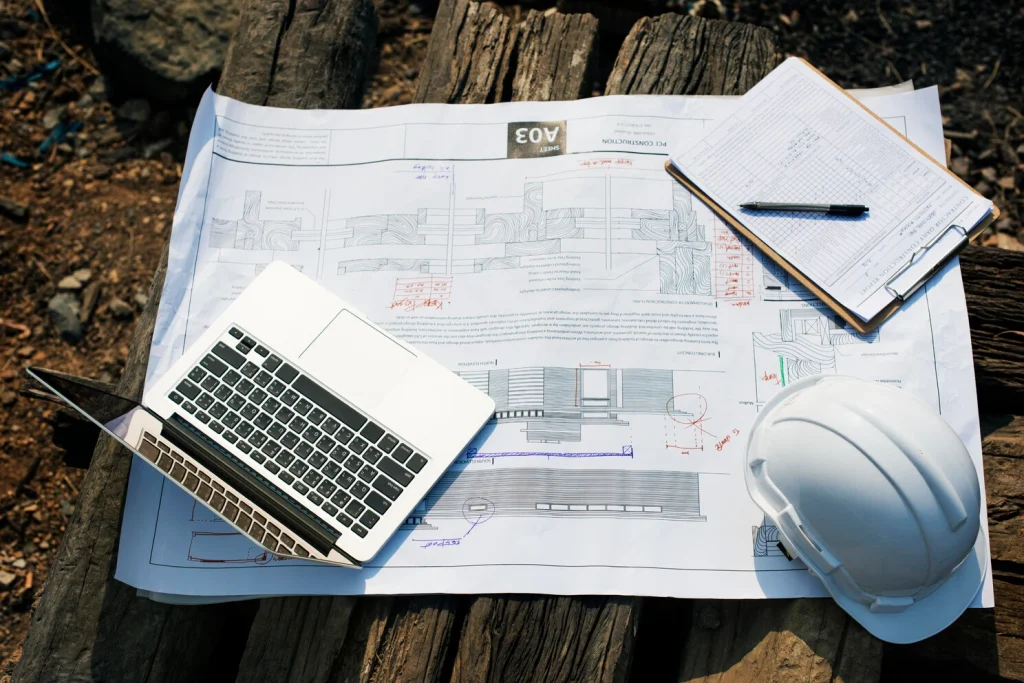
Once the hierarchical structure (PBS or FLOCS) has been established, the framework is set for the actual collection and loading of material requirements. This process transforms the raw data from engineering into the actionable intelligence required for downstream activities.
This is a critical step of data validation and enrichment, where the BOM becomes the dynamic blueprint for procurement, warehousing and construction.
In a modern, integrated environment, the process moves beyond the static “Engineering BOM” (EBOM) generated by design software. While EBOM provides the initial list of parts and quantities, a robust materials management solution supports the creation of several BOM types, including:
- Multi-Level BOMs, which mirror the PBS/FLOCS hierarchy to show parent-child relationships and sub-assemblies.
- Manufacturing BOMs (MBOMs), which include additional details like packaging, consumables, and assembly instructions.
- Service BOMs (SBOMs), which are optimized for long-term maintenance and repair.
A critical consideration at this stage is capturing additional attributes required to support integration and downstream activities. By ensuring all necessary attributes are attached to each material record at this early stage, it creates a comprehensive baseline for all subsequent project materials management activities, from supply chain and warehousing to construction and eventual operation.
This proactive data enrichment minimizes late-stage scrambling for missing information, reduces costly procurement errors and ensures seamless execution across the entire asset lifecycle.
Key Questions to Ask:
- What type of BOM is required to support the business requirement (EBOM, MBOM, Service BOM, etc.)?
- How do you validate BOM data against the hierarchical structure and material master?
- Are you consistently capturing all necessary data attributes upfront?
Suggested Best Practices:
A BOM typically isn’t that complex. There are some key elements that a BOM must have to start the supply chain process, including:
- Unique Part Number & Commodity Code: Unique identifiers for each component.
- Quantity: The number of each part required.
- Unit of Measure: Defines how materials are counted.
- Description & Specifications: Provides clarity on components.
Additional information can be added after loading into a materials management solution to provide additional context:
- ERP Definitions: E.g., classification and characteristics.
- Procurement Type: Defines if parts are purchased or manufactured.
- Lead Time & Supplier Details: Helps with supply chain planning.
Revision Tracking
If controlled and contextualized information is an asset of the 21st century, then storing revision history is the crystal ball for organizations.
Materials are subject to constant change driven by design iterations, engineering updates and supply chain adjustments. In this dynamic environment, a disciplined approach to revision tracking is a strategic imperative.
If a standardized taxonomy and hierarchical structure provide the foundation for consistent materials data, then revision tracking acts as the historical record that unlocks an organization’s predictive and analytical capabilities. It moves materials management beyond the transactional to the strategic, transforming a project’s history into a valuable dataset for future endeavors.
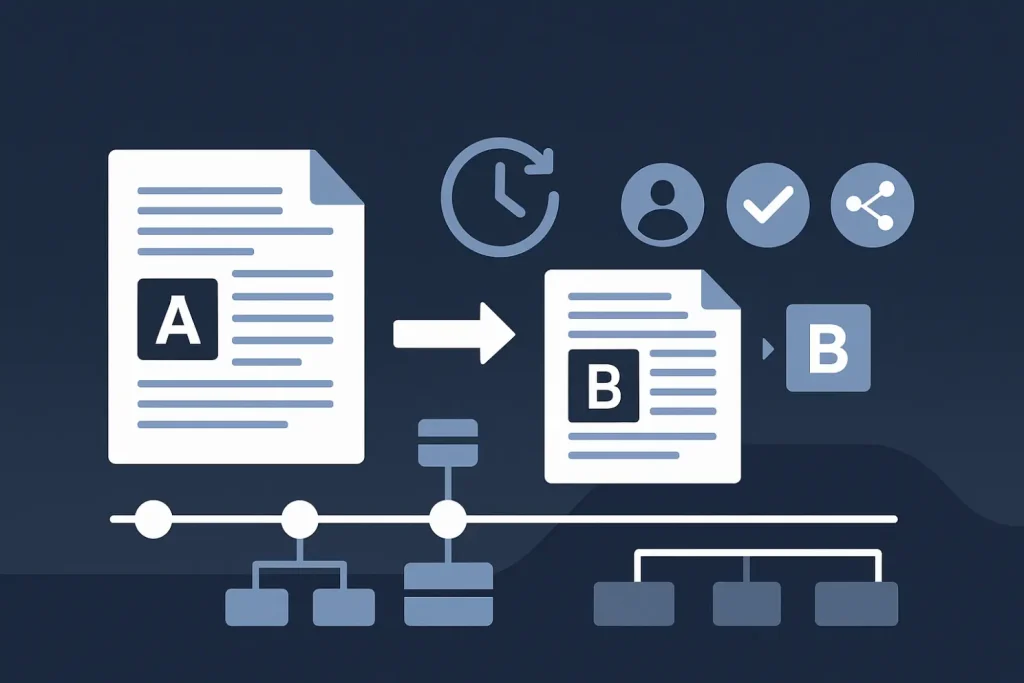
This involves documenting what changed, when it changed, who approved the change and the associated impact on linked documents and downstream processes. A robust revision strategy is essential for tying material requirement documents directly to their corresponding data.
By capturing this granular history, an organization can build a comprehensive audit trail that is invaluable for compliance, root cause analysis and dispute resolution.
Over time, this historical data becomes a potent source of business intelligence. Consistent revision tracking allows for trend analysis across multiple projects, enabling engineers and planners to predict future material needs, anticipate cost fluctuations and optimize inventory strategies.
For example, by analyzing revision patterns on similar projects, an organization can identify recurring design issues, leading to proactive standardization and process improvements. This visibility reduces the risk of rework, streamlines workflows and ultimately provides a significant competitive advantage by lowering project costs and accelerating execution.
The ability to look back at the documented journey of a material from concept to operation is what provides the foresight to reduce waste, control costs and build assets with greater efficiency and reliability.
Key Questions to Ask:
- Are there current milestones or stages where history needs to be recorded? If so, how many and at what level does history need to be tracked?
- Is your revision tracking truly integrated, or are you manually matching data to documents?
- How effectively does your revision strategy ensure data continuity at project handover?
Reporting & Analytics
Once materials data is collected, standardized and tracked within a modern materials management solution, it transforms from a static record into a dynamic, strategic asset. Effective reporting and analytics are the tools that harvest this rich data to drive tangible business value.
A materials management solution that provides trusted data can move an organization beyond reactive problem-solving to proactive, data-driven decision-making. This insight allows stakeholders to produce more accurate forecast demands and mitigate the risks associated with duplicate, outdated or missing information.
Interactive dashboards and customizable reports can visualize KPIs like material usage rates, procurement cycle times and inventory levels. This immediate access to information enables rapid identification of bottlenecks, potential delays or emerging issues before they escalate into costly problems. For example, by analyzing historical usage patterns, organizations can predict which materials will be in high demand, allowing procurement to negotiate better pricing and ensure availability.
Key Questions to Ask:
- What KPI’s need to be tracked (inventory, procurement cycles, etc.)?
- How will data be used for forecasting or planning?
- What additional data (i.e., from material master) will the BOMs need to support reporting needs?
Thinking About the Future
Material requirements can cover a lot of different commodity types. The simplest would be to focus on bulk commodities for the largest discipline (i.e., piping).
No matter where you decide to start, it is important to understand the current state of materials requirements for that discipline. This involves a comprehensive review of existing processes, systems and data quality to identify strengths, weaknesses and key areas for improvement.
Another key element is to establish cross-functional governance. An effective materials requirements process breaks down traditional silos, so it requires unified ownership and direction.
As an organization masters that aspect, it’s not unusual to expand the vision to optimize other project items or assemblies. Allow yourself and the organization to organically grow to meet the need. Look for continuous areas of improvement or new pain points. Don’t stop asking what’s next.
The ReVisionz Advantage
With decades of experience in asset-intensive industries, ReVisionz brings a deep understanding of operational realities to the table. We combine this domain knowledge with technical expertise to build scalable and resilient solutions that work in real-world environments.
We don’t focus on a single stage of materials management. Our approach encompasses the entire asset lifecycle, from the initial project phase (CAPEX) to long-term operations and maintenance (OPEX). This ensures continuity, prevents data gaps during project handover and supports the asset’s full lifespan.
For companies stuck on their digital transformation journey, we provide a clear roadmap based on business capabilities rather than simply implementing new technology for its own sake. Our structured, incremental approach helps clients achieve measurable value while building a sustainable digital foundation.
Continue your exploration of materials management by subscribing to our Digital Journey Notebook. And if your organization is seeking hands-on guidance, we’re here to design an approach that meets your goals.
6. Project Supply Chain
With material requirements defined and structured, the next stage of the capital project lifecycle focuses on execution by transforming planning and design data into physical movement and delivery.
Supply chain management is where the digital foundation of materials management meets the realities of fabrication, inspection and construction. It ensures that the right materials arrive at the right time and in the right sequence to keep project execution on track.
In capital projects, the supply chain is a core performance driver. From vendor qualification and contract negotiation to logistics coordination and goods receipt, every decision can affect safety, cost and schedule. A well-orchestrated supply chain enables seamless coordination among engineering, procurement and construction, ultimately turning what is typically a fragmented process into a connected system of control.
Why This Matters
For complex, asset-heavy projects, the supply chain represents both the greatest risk and the greatest opportunity for performance improvement. Late deliveries, missing documentation or unverified materials can cause cascading delays and unplanned costs.
By embedding digital visibility, integrated workflows and proactive controls, project teams can transform materials management into a predictive capability that drives certainty, reduces waste and ensures every component arrives construction-ready.
This chapter explores the key focus areas that together form the backbone of a connected, intelligent supply chain, including:
- Vendor & Supplier Engagement
- Contract Management
- Inquiry & Purchase Order Management
- Expediting & Logistics
- Technology Integration
- Financial & Schedule Integration
- Material Status Reporting & KPIs
Each of these functional areas play a pivotal role in building a transparent, efficient and data-enabled supply chain that supports both project execution and long-term operations.
Vendor/Supplier Engagement
In capital projects, vendor performance directly determines execution performance. Long-lead equipment, fabricated assemblies and bulk materials all depend on a network of qualified suppliers who can meet stringent technical, safety and schedule requirements. Effective vendor engagement transforms procurement from transactional purchasing into a strategic partnership model that supports both speed and accountability.
It begins with structured qualifications and onboarding. Vendors are assessed for capacity, quality systems, financial stability and compliance with project standards. Once approved, they are linked to a centralized vendor master, which is a digital record connected to the project’s materials management and Enterprise Resource Planning (ERP) systems. This ensures that every supplier interaction, from Request for Quote (RFQ) to goods receipt, is traceable and auditable.
During execution, vendor collaboration focuses on transparency and progress tracking. Digital supplier portals and dashboards allow real-time monitoring of manufacturing milestones, inspection hold points and documentation submittals. This visibility enables procurement and project controls teams to detect potential slippage early and trigger corrective actions before they impact the field construction.
Strong vendor engagement also underpins risk management. Suppliers are evaluated not only on performance but on resilience, demonstrated by their ability to adapt to changing schedules, material substitutions and expedited delivery demands.
A resilient project supply chain anticipates disruption long before it occurs. Supplier capacity constraints, geopolitical issues or logistics bottlenecks can all impact critical-path materials. Establishing supplier risk registers and developing contingency plans such as alternate sourcing, buffer stock or expediting options helps safeguard project schedules.
When risk data is integrated with project controls, leadership can gain early warning indicators that allow for proactive mitigation rather than reactive firefighting.
Key Questions to Ask:
- How do we qualify and track supplier performance across multiple fabrication packages and regions?
- Do we have real-time visibility into vendor progress, risk and documentation readiness?
- How are vendor communications and deliverables integrated into our project materials system?
Contract Management
In capital projects, contracts define the commercial backbone of the supply chain. They govern how materials are sourced, priced and delivered, and how risk is shared between the owner, EPC and supplier. Without structured, digitally integrated contract management, organizations may face uncontrolled commitments, inconsistent terms and limited visibility into supplier obligations.
Effective contract management starts with standardization. Framework agreements, unit rate contracts and long-lead equipment terms should all be based on defined templates and governance workflows. This ensures compliance with corporate standards and accelerates approvals. Digitally linking these contracts to ERP and procurement systems also provides real-time tracking of commitments, budget consumption and delivery obligations.
Strategic sourcing further strengthens project control. By leveraging bulk agreements and pre-negotiated pricing with critical vendors, organizations can secure capacity, reduce cost volatility and compress procurement cycles. This is particularly important in multi-project environments, where shared vendors support parallel builds or expansion programs.
When contracts are actively monitored and digitally connected, they evolve from static documents into live control mechanisms. Teams gain visibility into performance, cost and delivery risk, ensuring that every purchase order is executed under a consistent framework of governance and accountability.
Key Questions to Ask:
- Are our contract terms standardized and digitally accessible across projects?
- How do we monitor contract compliance and performance against schedule milestones?
- Do our strategic agreements provide flexibility for changing project scopes and timelines?
Inquiry & Purchase Order Management
Inquiry management is the stage where engineering intent transitions into commercial commitment, and where project risk can either be mitigated or unintentionally amplified. In capital projects, inquiries are best structured as procurement packages aligned to engineering and construction work breakdowns rather than as isolated material requests.
By grouping materials into logical fabrication or installation units, procurement ensures that what is purchased supports field sequencing, reduces site congestion and strengthens vendor accountability. This creates a direct, traceable relationship between design deliverables, procurement scope and construction readiness.
The inquiry process is also a primary opportunity to prevent downstream rework and change orders. Vendor technical clarifications, specification confirmations and scope delineations should be resolved before award, when alignment is still flexible and contractual leverage is high.
A disciplined inquiry process brings engineering, procurement and construction stakeholders together to confirm quantity accuracy, revision status, quality requirements and delivery expectations. When inquiries are handled proactively, the supply chain becomes a stabilizing force rather than a source of uncertainty.
Bid evaluation must balance cost, capability, schedule assurance and demonstrated performance rather than price alone. Digital comparison tools support objective analysis of vendor responses and allow risks, assumptions and deliverables to be evaluated consistently across suppliers. Award decisions incorporate both the vendor’s technical competence and their proven ability to execute reliably within the project’s schedule constraints. In this way, evaluation becomes not just a commercial decision, but a selection of execution partners.
Once the preferred vendor is selected, the Purchase Order (PO) formalizes scope, schedule and quality expectations. For fabricated equipment and engineered materials, POs should define milestone-based deliverables, including inspection hold points, manufacturing progress updates, data book submittals, test records and shipping documentation. Where materials are delivered directly affects risk ownership and timing of site receipt. Incoterms should be explicitly defined and aligned with the project’s logistics and warehouse strategy to support the construction schedule.
These deliverables are treated as part of material readiness rather than afterthoughts. Tying progress payments or release authorizations to the completion of deliverables reinforces accountability and ensures that materials arrive installation-ready.
By managing inquiries and purchase orders with this level of rigor, organizations create a closed-loop procurement process that supports schedule certainty, reduces rework and aligns all parties to the realities of project execution. What begins as a transactional exchange becomes a structured framework for controlling both material flow and project performance.
In most capital projects, procurement success is measured by how well materials align with construction needs, not just how quickly purchase orders are issued. A construction-driven supply chain synchronizes material deliveries with work package schedules, ensuring that critical items arrive in sequence and on time for installation.
By integrating material plans with engineering and construction work packages (EWP, CWP, MWP), project teams can minimize idle inventory, reduce laydown congestion and maintain productive work fronts. This approach transforms materials management from reactive expediting to proactive, schedule-driven coordination that directly supports predictable field execution.
Key Questions to Ask:
- How well do our inquiry and procurement packages align with engineering and construction work packages to support installation sequencing and field readiness?
- Are scope, technical clarifications and documentation requirements resolved before award to prevent downstream change orders, fabrication delays or rework?
- Do our purchase orders include milestone-based deliverables and progress visibility (fabrication updates, inspection points, data books) that enable proactive expediting and schedule assurance?
Expediting & Logistics
The moment a purchase order is issued, the focus shifts to execution to ensure that materials are produced, inspected and delivered as planned. Expediting and logistics bridge the gap between supplier manufacturing and site installation, and their effectiveness directly influences schedule adherence.
Expediting begins with proactive supplier engagement. Fabrication progress, testing milestones and documentation deliverables are tracked against defined dates. Digital expediting tools and supplier portals enable real-time status updates, flagging delays or deviations early on. This transparency helps project teams re-sequence activities or adjust logistics to maintain construction readiness.
Inspection ensures that materials meet project standards before shipment. Digital inspection records feed directly into materials management systems, eliminating paper-based reports and reducing turnaround time. Integrated document management also ensures certificates, data books and release notes are linked to material IDs for traceability.
RFID and digital Track-and-Trace technologies further enhance visibility and control across the expediting and logistics process. By tagging critical components, fabricated assemblies and bulk materials, project teams can monitor location, transit status and chain-of-custody in real time. Integration with supplier systems and transportation carriers enables proactive management of potential delays and ensures that site teams know exactly when materials will arrive and where they will be located upon receipt. This transparency reduces search time, minimizes loss and ensures that construction crews have the right materials available when needed. This supports schedule certainty and installation readiness.
Once released, logistics coordination provides safe and timely delivery to site or laydown yards. Advanced tracking through GPS, barcoding or RFID provides real-time visibility of shipments, customs status and estimated arrival. Automated goods receipt processes then update project inventory and trigger progress payments.
Together, expediting and logistics form the operational heartbeat of the capital project supply chain, ensuring every component arrives safely, compliantly and on schedule. In capital projects, materials are not truly complete until their documentation is received. Missing inspection reports, material test records or release certificates can delay system handover and commissioning.
Digitally managing these documents and linking them to specific material line items and shipment records ensures that quality and compliance data move with the material through every stage. When documentation readiness is tracked alongside physical progress, turnover becomes a predictable milestone rather than a last-minute scramble.
Key Questions to Ask:
- How do we track supplier manufacturing progress and documentation readiness?
- Are inspection results and release certificates integrated into our project systems?
- Do we have real-time visibility of shipments, transit risks and delivery performance?
Technology Integration
Technology is the foundation of a connected supply chain. In capital projects, where thousands of materials move through global suppliers, fabrication shops, transit lanes, warehouses and job sites, digital integration provides the visibility and control needed to maintain schedule and cost discipline. The objective is to ensure that every material movement is synchronized with engineering progress and construction priorities.
Integrated materials management platforms connect engineering, procurement, expediting, inspection, logistics and construction systems. This ensures that data from RFQs and contracts to fabrication milestones, shipment releases and goods receipts flows seamlessly across the lifecycle.
APIs and shared data standards reduce manual entry, eliminate duplication and maintain alignment between teams. When these systems are tied to work packaging structures (EWP, CWP, MWP), material readiness can be assessed directly against installation needs, not just delivery dates.
Advanced tools such as RFID, IoT sensors, GPS tracking and analytics dashboards provide real-time insight into material status and movement. Teams can monitor fabrication progress, identify bottlenecks, track shipments in transit and forecast arrival dates with precision. Predictive analytics highlight at-risk materials before they impact the schedule, while mobile applications give field teams immediate access to availability, location and documentation status at the point of installation.
Equally important is document traceability. Inspection records, material test reports, data books, release certificates and supplier turnover packages are captured digitally and linked to unique material identifiers. This ensures that materials do not just arrive on time, but they arrive installation ready, with full compliance and handover support built in.
By connecting technology across the supply chain, organizations convert information into control. This digital thread becomes the backbone of project readiness, unifying engineering intent, procurement execution, fabrication progress, logistics flow and field installation sequencing. The result is fewer surprises, tighter coordination and improved schedule assurance across the entire project lifecycle.
Key Questions to Ask:
- Do our materials management, procurement, expediting and construction systems share a single, integrated data thread that allows real-time visibility of material readiness across the project?
- Can field teams, procurement leaders and project managers easily see the status of fabrication milestones, shipping progress and documentation readiness (MTRs, ITPs, data books) in one place?
- Are advanced tracking tools (RFID, GPS, IoT) and analytics dashboards being used to proactively identify bottlenecks and support schedule-driven decision making, rather than reactively chasing material status?
Financial & Schedule Integration
Supply chain performance directly determines cost and schedule outcomes in capital projects. Aligning financial and scheduling data with procurement and expediting systems ensures that commitments, deliveries and installation are coordinated to support field productivity. The objective is not only cost visibility, but it is to ensure that material readiness drives schedule readiness.
In mature organizations, purchase orders, fabrication progress reports, shipment releases and goods receipts are directly linked to project cost accounts and construction work packages. This enables earned value measurement based on verified progress, not assumptions or manual updates. When payment release is tied to milestone deliverables such as inspection records, data books and documentation readiness, vendors are incentivized to deliver fully compliant, installation-ready materials rather than just shipping early.
Schedule integration adds another layer of control by linking procurement milestones to the MWP/CWP execution sequence. Real-time visibility into fabrication status, transit tracking, customs clearance and site receiving allows project teams to identify material-driven schedule risks before they impact work fronts. Early warning indicators highlight where resequencing, expediting or contingency planning may be required to protect critical path progress.
By integrating cost, schedule, procurement, expediting and construction data into a single digital view, supply chain reporting shifts from retrospective tracking to predictive readiness management. Project leadership gains a clear, real-time understanding of where materials stand in relation to the plan, enabling informed decision making, improved coordination and more reliable execution outcomes.
Key Questions to Ask:
- Are procurement and expediting milestones directly linked to cost accounts and construction work packages to support installation readiness?
- Is payment release tied to verified material and documentation deliverables, rather than shipment alone?
- Do project teams have real-time visibility into how material status affects the critical path and field productivity?
Material Status Reporting
Visibility is the foundation of control. Material status reporting must provide more than shipment dates. It must show whether materials are installation-ready and aligned to the work packages that drive construction execution. In capital projects, the ability to confirm what is needed, where it is, whether it is complete and whether it can be issued to a work front without delay is essential to maintaining schedule continuity.
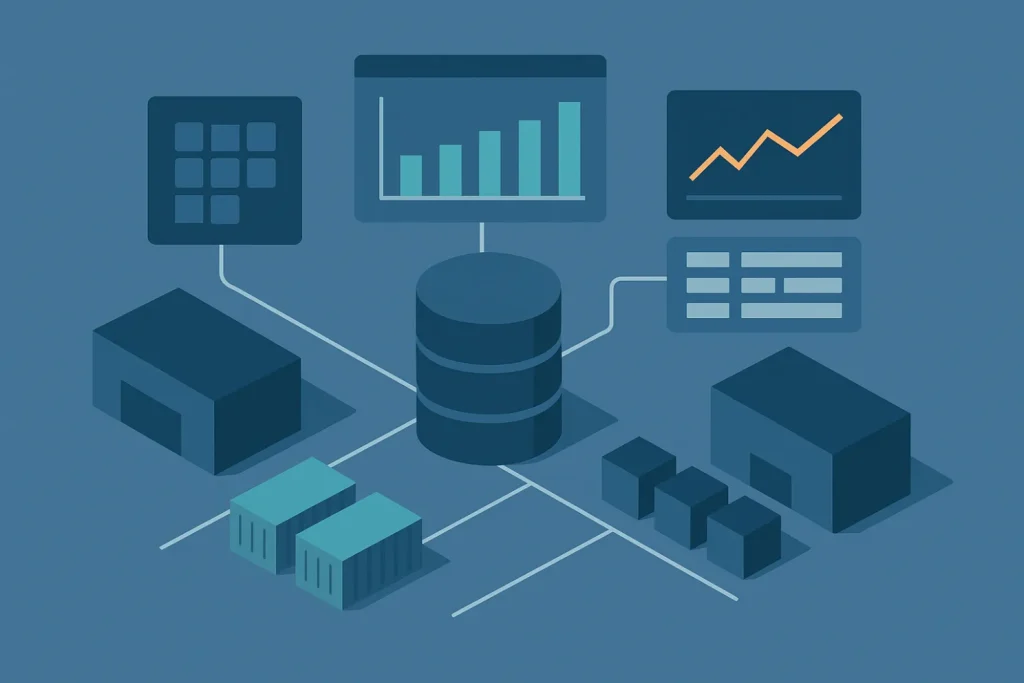
Effective reporting integrates data from procurement, expediting, inspection, logistics and site receiving into a unified material readiness dashboard. Key performance indicators (KPIs) reflect the true state of progress, including fabrication milestones achieved, inspection and documentation completeness, shipment and transit status, warehousing location and readiness to support specific construction work packages.
Role-based visibility ensures that engineering, procurement, expediting and construction teams operate from a single version of truth, reducing coordination gaps and preventing last-minute disruptions.
Leading organizations can evolve reporting into predictive analytics. By leveraging real-time status updates, historical vendor performance, production lead times and in-transit tracking, they can forecast material bottlenecks before they affect the schedule. This proactive insight enables corrective action (expediting, resequencing, alternate sourcing, or adjusting work-front planning), turning data into a strategic advantage that protects critical path performance and overall project predictability.
Key Questions to Ask:
- Do project teams have real-time visibility into material readiness including documentation status, aligned to specific construction work packages?
- Are KPIs focused on installation, readiness and schedule assurance, rather than just delivery tracking or spend reporting?
- Can we forecast material-driven schedule risks early enough to resequence the work or expedite action before field progress is affected?
Thinking About the Future
The capital project supply chain is moving from reactive coordination to predictive orchestration, where material readiness is understood and assured long before execution in the field.
Advances in AI, digital twins and real-time analytics are enabling teams to model the fabrication progress, simulate delivery sequences and forecast installation readiness at the level of individual construction work packages. RFID, IoT sensors and connected platforms are extending the digital thread across suppliers, carriers, warehouses and job sites, creating continuous visibility of both physical materials and their associated documentation.
In this future state, supply chain systems do more than track status. They anticipate constraints and recommend proactive actions such as resequencing work, accelerating inspection, reallocating inventory or triggering contingency logistics. Material work packages become dynamic digital entities that are updated automatically as engineering evolves and field conditions change. The result is a supply chain that not only enables construction, but it also optimizes it to continuously align supply with demand to protect the schedule.
The organizations that lead in this space will be those that invest in data quality, system integration and connected execution, transforming the supply chain from a transactional support function into a strategic performance engine that drives certainty, confidence and competitive advantage.
The ReVisionz Advantage
ReVisionz is a strategic partner in helping organizations clarify where they are today and chart a confident path forward. We work alongside project, supply chain and leadership teams to assess current practices, identify improvement opportunities and define a roadmap that aligns people, process, data and technology around a common vision.
Our approach brings structure and clarity to complex environments, enabling organizations to strengthen coordination, enhance visibility and improve predictability across the project supply chain. With ReVisionz, transformation is a guided journey toward a more connected, reliable and high-performing way of working.
If you want to build a clearer and more connected materials workflow, follow this series as it unfolds. Subscribe for updates or connect with us to talk about what matters most to your organization.
7. Construction Warehouse Management
With the project supply chain delivering materials to site, the focus in chapter 7 shifts to how those materials are received, controlled and issued to support construction execution without disruption.
Once materials arrive on site, the warehouse becomes the control point that determines whether construction progresses predictably or is disrupted by avoidable delays. In capital projects, the construction warehouse is an operational hub responsible for converting delivered materials into installation-ready assets. Its effectiveness directly influences craft productivity, field coordination, cost control and schedule reliability.
As such, the warehouse must balance two critical objectives: maintaining control while enabling flow. It needs to preserve material integrity, traceability and accountability while also supporting timely distribution to work fronts with minimal wait time or rehandling. When warehouse operations are aligned with construction sequencing and execution plans, the warehouse becomes an active enabler of installation readiness ensuring crews have what they need, when they need it, to execute work safely and efficiently.
As projects adopt more integrated materials management practices and structured Workface Planning models, warehouse operations emerge as a pivotal link in the connected project supply chain. Digital receiving, RFID and barcode tracking, mobile warehouse tools and kitting workflows shift the organization away from reactive material chasing toward intentional staging and controlled issuance. In this model, the warehouse does not simply hold materials; it verifies, documents, tracks and positions them to support installation at the right point in the build sequence.
The objective of construction warehouse management is therefore simple, but strategic: to ensure materials transition smoothly from delivery to installation with full visibility, minimal waste and no surprises. When executed effectively, warehouse operations accelerate construction progress, improve predictability and protect both cost and schedule, making the warehouse a foundational contributor to overall project performance.
Warehouse & Laydown Strategy
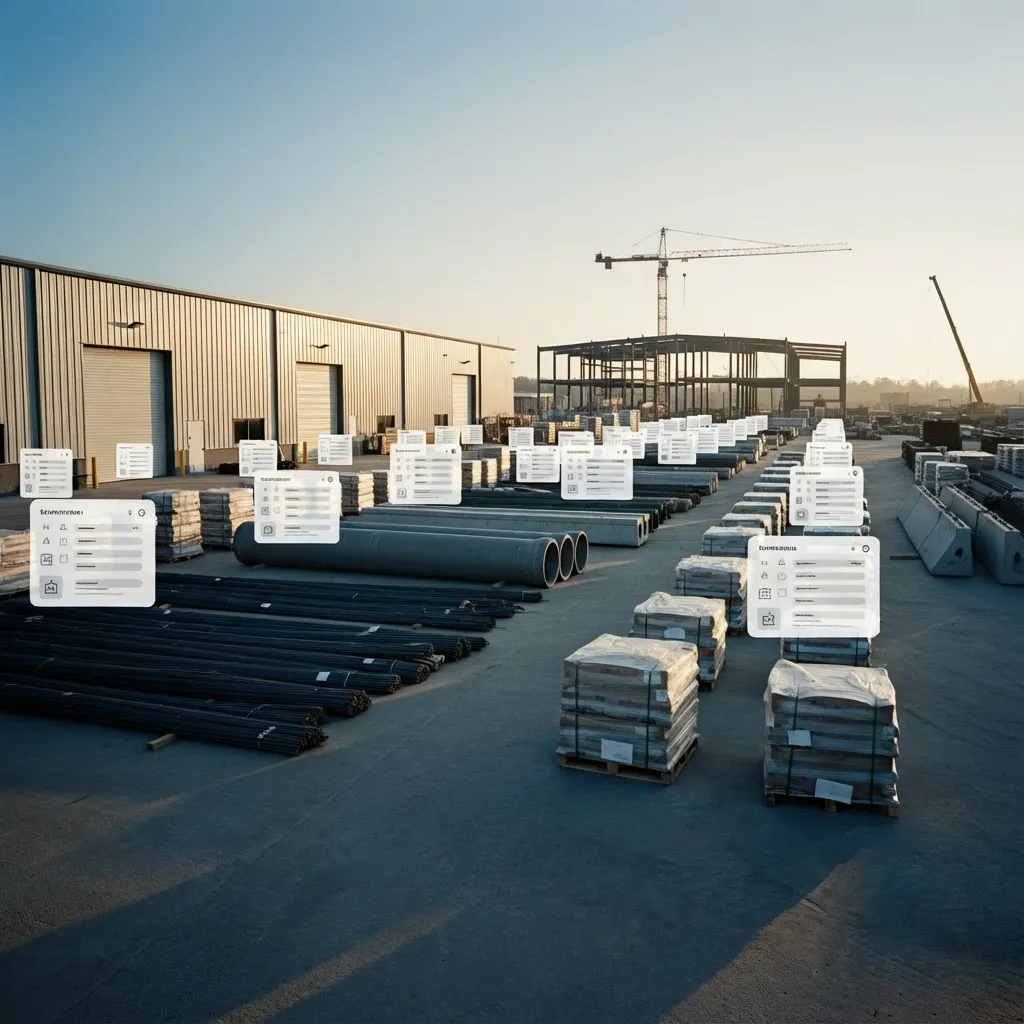
In capital projects, warehouse and laydown areas are strategic assets that shape construction flow and execution efficiency. Their purpose is not storage for its own sake, but to support material readiness aligned to construction sequencing. A well-designed warehouse strategy integrates physical layout, zoning, handling practices and digital visibility with how work will be executed in the field.
Effective warehouse planning begins early in the project lifecycle. Decisions regarding indoor versus outdoor storage, proximity to work areas, environmental protection requirements and access routing must be made in the context of construction phasing and work packaging. When warehouse and laydown planning are embedded within the construction execution model rather than treated as a downstream logistics task, material flow becomes more predictable, and field disruptions are reduced.
Strategic grouping and positioning of materials based on anticipated installation needs minimizes unnecessary movement, reduces rehandling and shortens retrieval time. This improves coordination between warehouse teams, construction supervision and work planners, creating an environment where materials move purposefully through the site rather than accumulating reactively.
Key Questions to Ask:
- Is the warehouse layout designed around construction sequencing rather than storage convenience?
- Are materials grouped and staged based on how and when they will be installed?
- Do warehouse planning decisions actively support installation readiness and field
- Productivity?
Receiving & Verification
Receiving is the first point of control at the construction site where the digital supply chain becomes physical. At this stage, materials must be validated against purchase orders, specifications and documentation requirements to ensure they are complete, compliant and suitable for installation. A disciplined receiving process prevents downstream confusion and eliminates issues that become more costly to resolve once materials are staged or issued.
Modern receiving relies on digital verification, not paper-based checks. Barcode or RFID scanning establishes a real-time link between the physical material, its documentation and its assigned storage location. Capturing inspection records, certificates and release documentation at receipt ensures that materials do not later stall installation due to missing or incomplete records.
Over, Short & Damaged (OS&D) and Nonconformance management are critical elements of the receiving process. Incorrect quantities or damaged material needs immediate resolution with the supplier to ensure future workface planning is not impacted. Materials that do not meet specifications must be clearly identified, isolated and tracked until resolution. Preventing non-compliant materials from entering general circulation protects quality outcomes and avoids costly rework, schedule delays and field disruption.
Key Questions to Ask:
- Are materials digitally verified at receipt to establish traceability and documentation readiness?
- Are nonconforming materials clearly isolated and managed through defined resolution workflows?
- Does the receiving process update system records in real time to support planning and visibility?
Material Identification & Tagging
Clear and consistent material identification underpins effective warehouse control and efficient material flow. Tagging materials with barcodes or RFID identifiers connect each item to its digital record, ensuring that status, documentation and location information remains accurate throughout the warehouse lifecycle.
Digital location assignments are equally important. Materials must be associated not just with a warehouse or yard, but with a specific bin, rack, row or zone. When location data is precise and accessible, warehouse operators and field teams can quickly locate materials, reduce search time and eliminate uncertainty during staging and issuance.
Strong identification practices improve coordination, reduce handling errors and increase confidence that the correct materials are delivered to the correct work fronts. This level of traceability is essential for maintaining installation readiness at scale.
Key Questions to Ask:
- Are all materials consistently tagged upon receipt?
- Can teams quickly identify the exact physical location of required materials?
- Is material identification fully integrated with the digital materials management system?
Storage, Protection & Handling Controls
Storage, protection and handling controls play a direct role in protecting both cost and schedule performance. Materials that are damaged, degraded or misplaced introduce rework, replacement costs and installation delays that ripple across the project. Effective storage is therefore not passive, but it is a strategic safeguard for execution reliability.
Protection requirements vary by material type, environmental exposure and sensitivity. Applying these controls consistently prevents corrosion, contamination, deformation or premature deterioration that can render materials unusable or require costly remediation. Preservation failures often surface late, when materials are needed for installation, making their impact both expensive and disruptive.
Handling practices must also support efficient flow. Poor handling increases damage risk, consumes labor and introduces delays through repeated movement. When storage layouts are designed around anticipated usage and issuance sequence, rehandling is minimized, retrieval is faster and installation readiness is preserved. Together, these controls reduce waste, protect quality and maintain the schedule integrity.
Key Questions to Ask:
- Are storage and protection requirements clearly defined and enforced based on material risk?
- Does the storage layout minimize handling and support efficient retrieval?
- Are preservation and inspection activities integrated into routine warehouse operations?
Work Package Staging
Work package staging (often referred to as kitting) represents the transition from material control to productivity enablement. By assembling materials required for specific installation scopes, warehouse teams ensure that crews arrive at the work front with everything needed to execute work without interruption. This reduces wait time, eliminates searching and stabilizes crew productivity.
Effective kitting depends on alignment with short-term construction lookahead planning. Materials must be grouped, verified and staged in advance of scheduled work, with both quantity and documentation completeness confirmed. When this alignment exists, construction supervision can commit to execution with confidence, knowing that material constraints have been resolved upstream.
Kitting also improves safety and quality outcomes by reducing congestion and ad-hoc handling at the workface. It reinforces a disciplined execution model where work is released only when it is truly ready to proceed.
Key Questions to Ask:
- Are materials kitted and staged in alignment with near-term construction plans?
- Do kitting processes ensure completeness before materials are released?
- Are staging areas designed to support predictable, uninterrupted installation?
Issuance & Workface Delivery
Material issuance is the moment where warehouse operations directly enable field execution. Mature projects treat issuance as both a controlled pull process and a planned release aligned to construction sequencing. This ensures materials are delivered intentionally, rather than reactively, and that issuance supports rather than disrupts workface productivity.
Digital issuance tracking preserves accuracy and traceability while providing real-time visibility into material movement. Point-of-use delivery reduces travel time, search effort and handling at the workface, allowing crews to remain focused on productive installation activities.
Well-executed issuance reinforces trust between warehouse teams and field supervision, enabling smoother coordination and fewer last-minute disruptions.
Key Questions to Ask:
- Is material issuance aligned to construction plans rather than ad-hoc requests?
- Are issuance transactions digitally recorded to maintain system accuracy?
- Does delivery minimize handling and crew downtime?
Inventory accuracy is fundamental to planning confidence and schedule reliability. When system records reflect physical reality, planners and supervisors can release work, knowing materials are available and ready for use. Inaccurate inventory undermines trust, drives contingency behavior and leads to inefficiency.
The ultimate objective in a capital project is to consume materials as planned and close out with minimal remaining inventory. In practice, however, residual materials often remain due to design changes, scope adjustments, over-procurement, or contingency purchasing. Accurate inventory records are therefore essential not only for day-to-day execution, but also for identifying surplus early enough to influence decisions such as reallocating materials to upcoming work, canceling pending deliveries, or adjusting procurement strategies.
Project warehouse management must also address inventory disposition planning, not just reconciliation. Remaining materials may need to be transferred to operations, returned to vendors, scrapped, or redeployed to other projects. These outcomes require clear ownership, defined processes, and designated physical space. When disposition planning is left until late in the project, warehouses become congested, accountability becomes unclear, and the transition to operations is disrupted.
Leading organizations define inventory transition strategies early identifying what materials are expected to roll into operations, which may be returnable under contract terms, and which require special handling or disposal. This early clarity ensures that the right stakeholders are engaged, appropriate storage and inspection areas are allocated, and systems are prepared to support ownership transfer. In this way, inventory accuracy and reconciliation extend beyond warehouse control to support orderly project closeout, smoother handover to operations, and reduced financial leakage.
Key Questions to Ask:
- Does the inventory system accurately reflect physical availability?
- Are reconciliation activities integrated into daily operations?
- Does the Project Materials Management plan incorporate inventory transition strategies to operations?
Digital Tools & Field Enablement
Digital tools are foundational to transforming construction warehouse operations from localized, manual activities into an integrated extension of the project supply chain. A robust materials management solution provides the single source of truth that connects receiving, storage, staging, issuance and inventory reconciliation across both the jobsite and the home office. When warehouse systems are fully integrated with procurement, expediting, cost control and construction planning platforms, material status becomes transparent, reliable and actionable at every level of the organization.
In the field, mobile-enabled warehouse tools support real-time execution. Barcode and RFID scanning, digital location management and mobile transaction processing eliminate manual data entry and reduce errors that erode confidence in inventory records. Warehouse personnel can confirm receipt, movement and issuance immediately, while construction supervision gains instant visibility into material availability without relying on phone calls, spreadsheets or physical searches. This responsiveness reduces delays at the workface and improves coordination between warehouse teams and construction operations.
Equally important is integration with enterprise systems in the home office. When warehouse data flows seamlessly into materials management, ERP, project controls and reporting platforms, leadership gains a clear, current view of material readiness, inventory exposure, and risk. This integration enables proactive decision-making around resequencing, expediting, preservation planning and inventory optimization. Over time, analytics derived from these systems support continuous improvement by identifying bottlenecks, recurring discrepancies and opportunities to reduce handling, storage duration, and excess inventory.
When digital tools are aligned to warehouse processes and embedded into daily workflows, technology becomes an enabler of control rather than an administrative burden. The result is a warehouse operation that is predictable, auditable and responsive, capable of supporting project execution with confidence and scale.
- Is there a single materials management system that connects warehouse operations with procurement, project controls and construction teams?
- Do field and warehouse teams rely on real-time digital tools rather than manual tracking or informal communication?
- Does current warehouse infrastructure (mobile internet, WiFi boosters and data security match the data integration requirements to track as efficiently as possible?

KPIs & Material Readiness Metrics
Performance measurements in construction warehouse management must extend beyond transactional efficiency to focus on material readiness and execution reliability. Traditional metrics such as receipts processed or inventory value on hand provide limited insight into whether the warehouse is truly supporting construction progress. Instead, KPIs should answer a more critical question: are materials available, verified and positioned to support planned installation without delay?
The most effective metrics measure readiness in context. This includes visibility into whether materials are physically available, properly stored, documented and accessible when required. Readiness-focused KPIs allow project teams to identify risks early, adjust staging or sequencing plans and avoid last-minute disruptions that lead to crew downtime or work re-sequencing. When readiness metrics are aligned with construction priorities, warehouse performance becomes directly tied to schedule confidence rather than isolated operational output.
Supporting efficiency metrics remains important, but they serve as enablers rather than end goals. Measurements such as inventory accuracy, issuance cycle time and retrieval efficiency provide insight into the health of warehouse processes and controls. When reviewed alongside readiness indicators, these metrics highlight where improvements in layout, tagging, staffing or digital tools can strengthen reliability and reduce waste. This balanced approach ensures the warehouse operates with both discipline and purpose.
By establishing KPIs that reflect material readiness and operational effectiveness, organizations create transparency and accountability across warehouse operations. Leadership gains confidence that material-related risks are visible and manageable, and warehouse teams understand how their performance contributes directly to project success.
Key Questions to Ask:
- Do warehouse KPIs clearly indicate whether materials are ready to support planned construction activities?
- Can readiness and inventory accuracy be assessed in real time, not through after-the-fact reporting?
- Are efficiency metrics used to drive continuous improvement rather than simply track activity?
Thinking About the Future
The future of construction warehouse management is defined by increased integration, visibility and predictive control. As projects grow in scale and complexity, warehouses must evolve from static storage facilities into dynamic operational hubs that anticipate demand and support execution with precision. Emerging technologies such as advanced RFID location tracking, automated inventory reconciliation and digital warehouse twins are enabling real-time awareness of material location, condition and availability across large and distributed sites.
In this future state, warehouse operations are no longer reactive to delivery or issuance requests. Instead, they operate with foresight using integrated data from procurement, logistics and construction schedules to anticipate material movement, staging requirements and preservation needs. This predictive capability reduces excess handling, minimizes congestion in laydown areas and shortens the time materials spend idle on site. As a result, inventory carrying costs decrease while material availability improves.
Ultimately, the future construction warehouse is not defined by technology alone, but by how well digital capabilities are aligned to disciplined processes and execution priorities. Organizations that invest in integrated systems, strong data foundations and clear operational models will position their warehouse operations as a strategic advantage improving cost control, protecting schedules and strengthening overall project predictability.
The ReVisionz Advantage
ReVisionz helps organizations assess warehouse management maturity and define a clear roadmap toward a more connected, execution-focused model. We work collaboratively across supply chain, warehouse and construction leadership to align processes, data and technology around the shared goal of installation-ready materials.
Through a collaborative, outcome-driven approach, ReVisionz brings structure and clarity to complex warehouse environments, enabling organizations to transition from reactive material handling to proactive, digitally enabled execution that delivers measurable improvements in cost, schedule and performance.
If you’re ready for ReVisionz to help you strengthen materials execution and installation readiness, reach out to our team to start the conversation. Subscribe for updates or connect with us to talk about what matters most to your organization.
8. Workface Planning
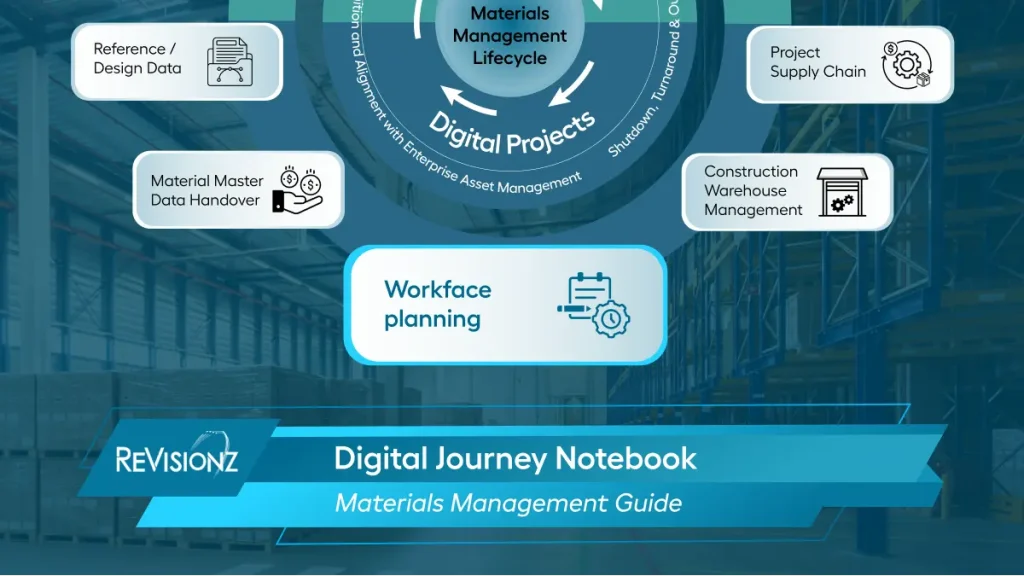
Workface Planning is where materials management directly influences whether construction execution is predictable or reactive. While it’s usually viewed as a construction planning discipline, its effectiveness is fundamentally dependent on how well materials are planned, staged, verified and released in alignment with installation sequencing. Without reliable material readiness, even well-defined work packages break down at the workface.
From a materials management perspective, Workface Planning provides the structure that connects engineering deliverables, procurement sequencing, construction warehouse operations and field issuance into a coordinated execution model. As a foundational element of Advanced Work Packaging (AWP), it defines how material demand is translated into executable installation scope and is released only when materials can support uninterrupted work. When this linkage is strong, material flow is purposeful and controlled, but when it is weak, crews experience issues such as waiting and excess site congestion.
Installation readiness is the measurable outcome of this alignment. It reflects whether materials required for installation are not only delivered, but verified, documented, staged and positioned to support execution in the planned sequence. In this context, readiness is a tangible condition that materials management either enables or undermines.
This chapter builds directly on the project supply chain and construction warehouse narratives by extending the same readiness mindset into workface execution. Just as materials are forecasted, staged and issued to support installation sequencing, Workface Planning ensures that work is released only when material readiness can be confidently confirmed.
Together, these disciplines replace reactive coordination with controlled execution, which allows for predictable and repeatable construction performance driven by material availability rather than material uncertainty.
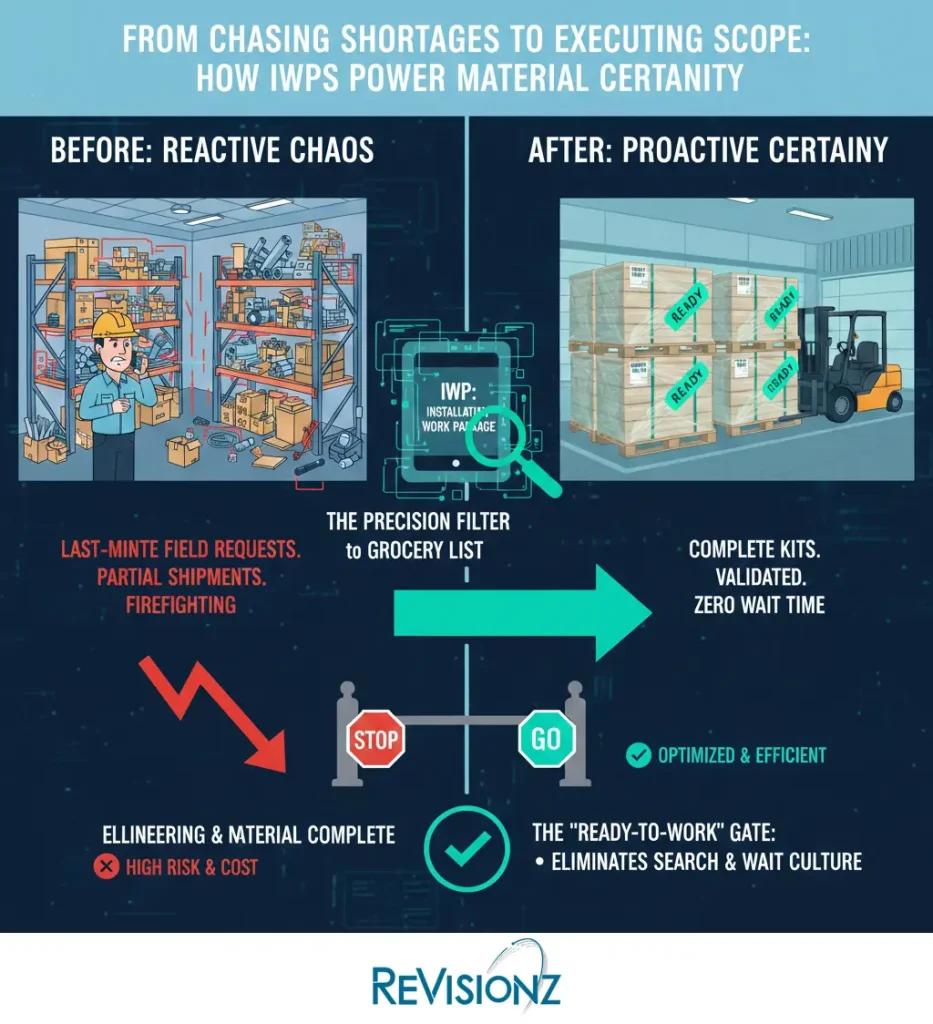
Workface Planning Framework & Work Packaging Discipline
From a materials management perspective, the value of Workface Planning lies in how work packaging clarifies material demand at the point of installation. Installation Work Packages (IWPs) provide the mechanism to translate engineering scope into discrete material requirements that can be planned, staged and issued with precision. When packaging is aligned to how materials are installed, it becomes possible to manage material flow deliberately rather than reactively.
Work packages establish clear boundaries for material scope, quantities and sequencing. This allows materials teams to prepare complete material sets, validate documentation and stage materials in advance of execution. Without this discipline, material demand remains vague, staging priorities become unclear and warehouses are forced into last-minute response mode driven by field requests rather than planned issuance.
Equally important, work packaging establishes governance for material readiness decisions. It defines when materials must be complete, who validates readiness, and how exceptions are handled. When this governance is consistent, materials management shifts from chasing shortages to supporting a controlled release of installation-ready material packages.
- Are work packages structured in a way that clearly defines installation-level material demand?
- Do IWPs provide sufficient detail to support accurate material staging and issuance?
- Is there clear ownership for validating material readiness before work is released?
- Do we have the necessary systems and people in place to properly execute?
Installation Readiness from a Materials Perspective
Installation readiness can be achieved only when materials are confirmed ready and not assumed ready. In practice, many productivity losses occur because work is released based on rather than true material readiness. Materials may be on site, but not staged, not kitted, missing documentation or not aligned to the installation sequence.
From a materials management standpoint, readiness means that the material required for a given IWP are complete, verified, documented and physically d to support efficient installation. This shifts readiness verification away from subjective judgment toward objective confirmation based on material status data.
A disciplined readiness approach also changes behavior. Instead of pushing materials to the field ‘just in case,’ the organization adopts a controlled release model where materials are staged and issued only when installation is imminent. This reduces congestion, limits damage and loss, and ensures that material availability supports productivity rather than disrupting it.
- Do we define installation readiness in terms of material completeness and staging, not just delivery?
- Are we taking the construction strategy into consideration when determining material readiness for fabrication and installation?
- Are incomplete material requirements treated as release blockers rather than field problems?
Material Readiness & Construction Warehousing
Material readiness is the operational bridge between warehouse management and workface execution. Warehouses do not simply store materials; they convert delivered items into installation-ready material packages. This conversion is achieved through receiving, identification, documentation control, kitting, staging and controlled issuance.
In a mature model, materials are staged specifically to support upcoming IWPs. Warehouse kitting and staging activities are driven by work package priorities rather than generic inventory management rules. This ensures that materials are positioned where they are needed, when they are needed and in the sequence they will be installed.
This approach also minimizes excess inventory at the workface. Rather than pushing materials forward prematurely, the warehouse supports a pull-based flow aligned to workface demand. The result is improved safety, reduced rehandling and clearer visibility into material readiness across the execution horizon.
Key Questions to Ask:
- Can the warehouse reliably stage complete material sets for upcoming IWPs?
- Is material readiness visible by work package, not just by item or purchase order?
- Are warehouse activities prioritized based on installation sequencing?
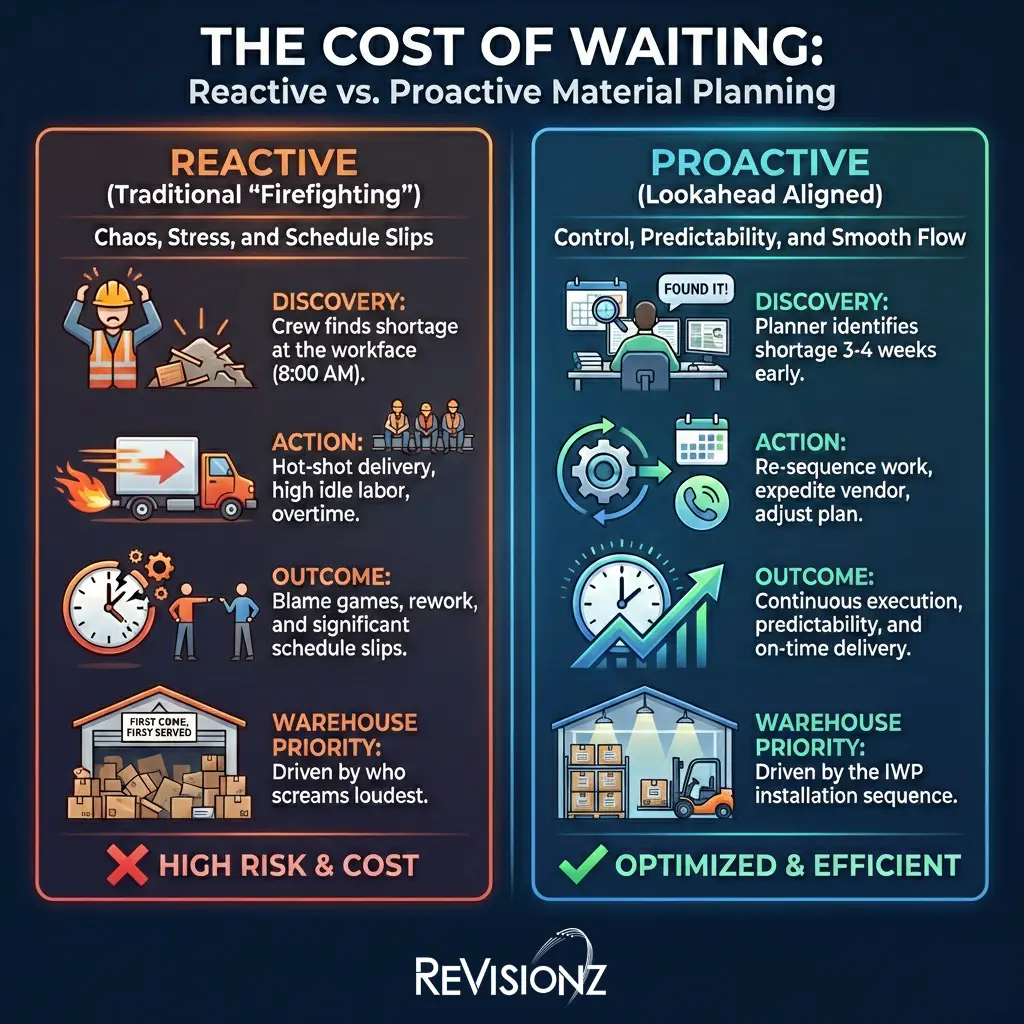
Material Forecasting & Lookahead Alignment
Material forecasting is what enables Workface Planning to be proactive rather than reactive. Effective forecasting translates the planned installation sequence into time-phased material demand that can be staged, verified, and issued ahead of execution.
In a materials-driven Workface Planning model, the lookahead window becomes the critical planning horizon. Within this window, upcoming IWPs are assessed against material availability, documentation status and staging readiness. Forecasting at the work-package level allows shortages and gaps to be identified early, when meaningful corrective action is still possible.
This forecasting discipline also supports risk management. When long-lead items, fabrication delays or documentation gaps are visible against upcoming installation needs, materials teams can adjust staging priorities, accelerate inspections or coordinate contingency actions. The result is a workface plan grounded in material reality rather than optimistic assumptions.
Key Questions to Ask:
- Do we forecast material demand at the IWP level within the lookahead window?
- Are potential material shortages identified early enough to influence execution planning?
- Is the lookahead plan used to drive warehouse staging priorities?
Work Release Discipline & Material-Driven Execution
Work release discipline is only as strong as material readiness discipline. Releasing work before materials are ready forces crews into workarounds, increases unplanned material movement and undermines confidence in the planning process.
In a materials-aligned Workface Planning model, work is released only when the associated material package is complete and staged. This creates a predictable cadence where warehouse operations, field supervision and materials management operate from the same readiness signal.
Feedback from execution is equally important. When work stalls due to missing or incorrect materials, those gaps must be captured and fed back into material planning and staging processes. Over time, this feedback loop improves readiness accuracy and reduces recurring material-related disruptions.
Key Questions to Ask:
- Is work release contingent on verified material readiness?
- Are material-related execution issues captured and analyzed for improvement
- Does material readiness performance influence future staging and forecasting decisions?
Digital Enablement for Materials-Driven Workface Planning
is critical and it is not just a home/engineering office issue, it extends into field activities. It makes material readiness visible, verifiable, and scalable. Realizing the requirement to identify key data, accurately store and report on that data is critical to shift this activity into the 21st century. Without integrated systems, material readiness is inferred through manual coordination, spreadsheets, and informal communication making it unreliable and difficult to sustain.
A strong digital foundation connects materials management systems, warehouse operations, and work packaging into a shared execution view. Planners can see whether materials for a given IWP are received, staged, documented and ready without relying on phone calls or field checks. Warehouse teams can prioritize staging based on upcoming work packages rather than reactive requests.
As data quality improves, digital tools also support forecasting and exception management. Dashboards highlight material gaps tied to upcoming IWPs, enabling earlier intervention. Over time, AI-enabled analytics can identify patterns in material readiness performance, such as recurring documentation delays or staging bottlenecks, allowing teams to address systemic issues before they impact execution.
The role of technology is to reinforce discipline. It ensures that readiness decisions are based on facts, that work is released intentionally, and that materials management operates as an integrated enabler of predictable execution.
- Do our systems provide real-time visibility into material readiness by work package?
- Is warehouse and materials data integrated into Workface Planning workflows?
- Are digital tools helping to effectively implement change that enforces readiness discipline rather than adding overhead?
Metrics & KPIs for Material-Driven Installation Readiness
Metrics should reflect whether materials management is enabling clean execution. The most valuable indicators measure material readiness by work package, not inventory volume or transaction counts.
Leading indicators include the percentage of IWPs with complete material readiness, aging of material-related constraints and staging accuracy. Lagging indicators include work stoppages caused by material issues, unplanned material movements and rehandling.
When metrics are aligned to work packages, they create shared accountability across materials, warehouse and field teams. This shifts performance conversations from reactive problem-solving to proactive readiness improvement.
Key Questions to Ask:
- Are we measuring material readiness as a leading indicator of execution performance?
- Does governance between materials, warehouse and field teams create shared responsibility?
- Do KPIs drive improvement in staging, forecasting and issuance discipline?
Thinking About the Future
The future of Workface Planning from a materials perspective is moving toward predictive material readiness. As materials data, warehouse systems and work packaging become more integrated, readiness will be assessed with increasing confidence before work is released.
AI will play an enabling role by analyzing patterns across material delivery, staging timelines, documentation completion and historical execution outcomes. These insights will help teams anticipate where material readiness is likely to break down and intervene earlier, improving schedule resilience and reducing expediting.
Digital work packages will evolve into living objects that reflect real-time material status. As materials are staged, issued or delayed, readiness signals will update automatically, allowing planners to adjust release decisions with greater speed and confidence.
The ReVisionz Advantage
ReVisionz helps organizations strengthen Workface Planning by grounding it in reliable materials readiness. We partner with teams as they shift from the engineering office to the site to assess current materials management maturity, warehouse alignment and readiness visibility. From there, we define pragmatic roadmaps that connect supply chain, warehouse and workface execution
As data quality and integration improve, ReVisionz can help organizations apply AI-driven insights to forecast material readiness, identify recurring constraints and support disciplined, readiness-based work release. This ensures materials management becomes a proactive enabler of predictable execution and not a reactive support function.
If your Workface Planning is still constrained by material uncertainty, ReVisionz can help. We work with teams to align materials management, warehousing and work packaging so execution is planned rather than improvised. Subscribe for updates or connect with us to talk about what matters most to your organization.
